
Deregistration Of Vat In UAE: Complete Guide To Eligibility, Process & Documents
Value Added Tax (VAT) is now an integral part of conducting business in the UAE from the time it was introduced in the year 2018. Although many companies focus on VAT registration, knowing the VAT deregistration process in the UAE is also crucial. If your business has been unable to make tax-deductible supplies, is closing operations, or does not meet the tax registration rules, you may have to terminate your VAT registration at the Federal Tax Authority (FTA).
Failure to deregister your VAT registration when required may lead to administrative penalties and ongoing VAT compliance obligations. This guide will explain all you need to be aware of regarding VAT deregistration in the UAE, including eligibility requirements, required documents, the procedure for applying, deadlines, and the most common errors to be aware of. Caviar accounting assists businesses across the UAE with VAT deregistration, VAT registration, tax filing, bookkeeping, and FTA compliance.
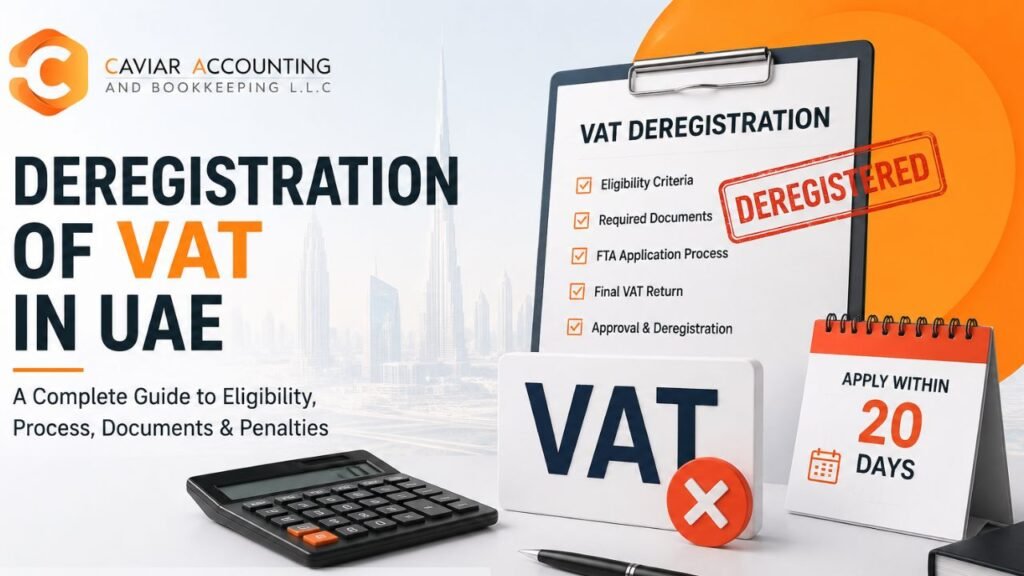
What Is VAT Deregistration In UAE?
VAT deregistration is the formal method of ending a business’s VAT registration through the Federal Tax Authority (FTA). When your deregistration request is accepted, your Tax Registration Number (TRN) will be inactive, and you’re not legally required to:
- Charge VAT on taxable supplies
- Send periodic VAT returns on a regular basis.
- Collect VAT from customers
- Recover input VAT on any future business expense.
But they must pay any outstanding VAT obligations and complete their VAT tax return prior to deregistration being completed. Before applying for VAT deregistration, it is helpful to understand who benefits from VAT, as VAT plays an important role in supporting public services while allowing eligible businesses to recover input tax.
Why Businesses Apply For VAT Deregistration
The eligibility criteria to deregister VAT within the UAE are clearly governed by law under the Federal Decree-Law and must be decided on the basis of current trading. Applications must be made within 20 days of becoming eligible in accordance with FTA guidelines. The following guidelines define those who are eligible to submit applications:
- The company has stopped producing taxable supplies entirely.
- The business is currently being closed down and legally wound up.
- The shift in the business or the corporate type results in the registration of VAT outdated.
- In the course of 12 months, the quantity of taxable supplies is lower than the voluntary tax registration threshold, which is AED 187,500.
When Is VAT Deregistration Required?
Businesses can request VAT registration under two types:
- Mandatory VAT Deregistration
The business has to apply for deregistration of VAT in the following situations:
- It permanently stops making taxable supplies.
- The company closes or gets liquidated.
- It is no longer planning to engage in taxable business activities.
- This does not fulfill the criteria for mandatory registration for VAT.
The application should generally be filed within 20 days following the day the obligation to deregister arises. In the event of a delay, it could be a cause for administrative fines.
- Voluntary VAT Deregistration
Businesses may request deregistration of VAT if:
The taxable supply of the company is under the registration threshold that must be met.
The company no longer wants to remain VAT registered. It is in compliance with the FTA requirements for eligibility.
The FTA scrutinizes every application prior to its approval.
VAT Deregistration Threshold In UAE
Type | Threshold |
Mandatory VAT Registration | AED 375000 |
Voluntary VAT Registration | AED 187500 |
Deregistration Eligibility | The business ceases to meet the requirements for VAT registration in accordance with the applicable regulations. |
Documents Required For VAT Deregistration
In order to apply for deregistration of VAT within the UAE Businesses must supply additional documents for the Federal Tax Authority (FTA) to confirm their eligibility. The documents required may differ according to the reasons for deregistering, like the closure of a business, liquidation, or a decline in taxable revenue. Making sure that the documentation is complete and correct will help you avoid delays when processing the application.
Before preparing the required documents, businesses should ensure that their financial records are accurate and up to date. Conducting an internal audit in the retail industry can help verify VAT records, invoices, and supporting documents, reducing the risk of delays or rejection by the Federal Tax Authority (FTA).
Commonly required documents comprise:
- A valid trade license or cancellation of trade license certificate (if the company has shut down)
- Tax Registration Number (TRN) details
- Reason for VAT deregistration and supporting documents
- Statements of financial responsibility or reports showing tax-deductible revenue
- Sales and purchase records for the relevant period
- Final Tax return (if appropriate)
- Documents that prove liquidation or business closure, for example, the liquidation certificate or close-down documents
- Emirates ID and passport copy of the person who is authorized to sign
- Power of Attorney (POA) or authorization letter when an authorized tax representative submits the application
Step By Step VAT Deregistration Process
The process of deregistering VAT in the UAE is done via FTA’s EmaraTax portal. Companies must make sure they satisfy the criteria for eligibility and complete all taxes prior to having their application considered for approval. Follow these steps:-
Step 1: Confirm Your Eligibility
Before you apply, consider whether your business is eligible to be deregistered from VAT. It is possible to be eligible when you have permanently stopped providing taxable services, shut down your company, or no longer meet the minimum requirements in order to be VAT registered according to UAE taxes.
Step 2: Gather The Required Documents
Make sure you have all the supporting documents ready prior to beginning the process. This could include the license for your business as well as documents for your finances, proof of closure (if appropriate), VAT return data, and any other documentation needed to be submitted by FTA. A complete set of documents can prevent any delays in the review process.
Step 3: Log In To The EmaraTax Portal
Log in to your account through the EmaraTax website using your login username and password. In your VAT dashboard, pick your VAT registration. Then, select the option of applying to deregister VAT.
Step 4: Complete The Deregistration Application
Complete the application online. Include reasons for deregistration and specifics about your company operations.
Step 5: Upload Supporting Documents
Upload all documents required in the specified format. Check that the files you upload are clear and conform to the details that you have provided on your application.
Step 6: Submit the Application
After review of your application and the supporting documents, send the VAT deregistration form by using your EmaraTax portal. After reviewing your application, you will receive an acknowledgement to confirm that the application was reviewed.
Step 7: Respond To FTA Queries (If Required)
During the process of reviewing your application, authorities such as the Federal Tax Authority may request further information or other documents. Make sure to respond promptly to inquiries to prevent unnecessary delay in the processing of your application.
Step 8: File Your Final VAT Return
Before the FTA approves your deregistration, you must file all outstanding VAT returns, including your final VAT return, and pay any outstanding VAT liabilities, interest, or administrative penalties.
Step 9: Get approval from the FTA
When the FTA determines that your business meets all requirements for VAT and your application is in compliance with the requirements for eligibility, the request for VAT deregistration is approved. After that, you are able to take a copy of the VAT Deregistration Certificate via the EmaraTax site to show proof that your VAT registration was removed from the official register.
How Long Does VAT Deregistration Take?
The time required for deregistration of VAT in the UAE depends upon the level of complexity in your application as well as whether your tax obligations are being met.
There are a variety of factors that can affect the processing time, such as:
Accuracy of Submitted Information
Make sure that the information provided in the VAT registration application is accurate and in line with the business records you keep.
Completeness of Supporting Documents
The submission of all documents required when you submit your application assists the FTA evaluate your request more quickly. Incorrect or missing documents could hinder the process of approval.
Outstanding VAT Returns
Prior to approving a deregistration application, the FTA obliges businesses to complete all VAT returns that are pending, which includes the final VAT return. All unfiled tax returns have to be filed before the request is processed.
Pending VAT Payments
Companies must pay any remaining VAT obligations and administrative penalties as well as any other taxes due before the VAT registration of their business is annulled. Insufficient funds can hinder the decision to approve the deregistration application.
If your company operates in the construction industry, read our guide on VAT on Construction Services to understand how VAT applies to construction contracts, invoices, and taxable supplies.
Common Mistakes To Avoid During VAT Deregistration
Applying for VAT deregistration may appear simple; however, small mistakes could delay the process of approval or cause administrative fines. One of the biggest misconceptions is the belief that cancellation of a trade permit instantly cancels the VAT registration. Actually, the process of deregistering VAT is an additional process which must be handled by the Federal Tax Authority (FTA).
Not Filing The Final VAT Return
Prior to the time that the FTA accepts an application for deregistration of VAT, all outstanding VAT returns, including the final VAT return, have to be presented. In the event of non-submission, it could slow the approval process.
Leaving Outstanding VAT Liabilities Unpaid
Unpaid tax, administrative penalty, or other tax obligations must be paid before deregistration can be finalized. Check that your tax accounts are completely cleared prior to submitting your application.
Submitting Incomplete Documentation
The absence of or insufficient supporting documentation is the top reason for delay. Take the time to review your documents and make sure that all files uploaded are correct, current, and fully.
Final Thoughts
The deregistration of VAT is a legal requirement for companies that are no longer tax liable or do not need to register VAT. Recognizing the eligibility requirements and preparing the correct documentation and meeting all remaining taxes can facilitate the smooth process of deregistration.
If your business is shutting down or restructuring or is no longer meeting tax registration rules, prompt intervention can help you avoid fines and ensure that your company is conforming to UAE taxes.
Looking for professional VAT deregistration services in the UAE? Connect with us for expert assistance in cancelling your VAT registration with the FTA quickly and in full compliance with UAE tax regulations.
FAQ
1. Is VAT deregistration mandatory?
Yes. If your company is no longer eligible for VAT registration, or has stopped making taxable products, you could have to file for VAT deregistration within the specified period.
2. Do I need to file a final VAT return?
Yes. Companies must file their final VAT returns and pay any remaining VAT obligations prior to when the FTA allows the removal of VAT.